Jan Bartek - AncientPages.com - A year ago, the skull of a Mixtec ancestor was returned to Mexico from the Netherlands. It had been on display for sixty years at the Wereldmuseum in Leiden, after the Dutch museum bought it from an American antique dealer in 1962.
Credit: INAH
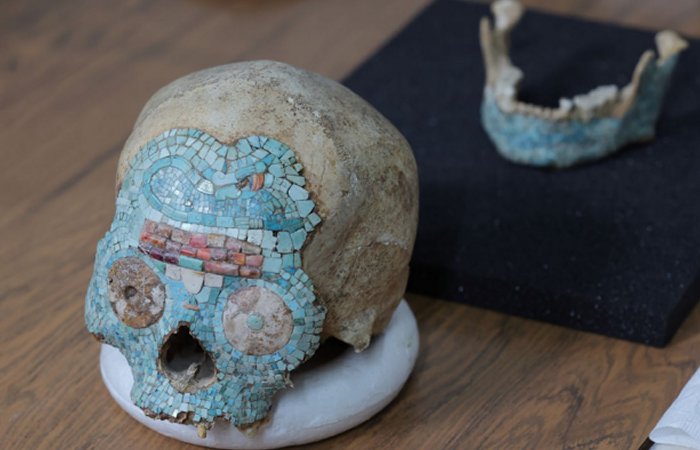
The skull is considered a fine example of Mixtec art. The Mixtec were a Mesoamerican civilization that thrived between 1200 and 1521. At the time, museums did not concern themselves with the object's origin, but now the skull has returned home.
Mexican institutions and civil society, led by the Nohivi Ñuu Savi collective, worked together to make the skull's return possible.
Credit: INAH
The Secretary of Culture of the Mexican Government, Claudia Curiel de Icaza, stated that “the recovery of this pre-Hispanic skull demonstrates that collaboration between authorities and civil society can translate into actions of historical justice. We recognize the initiative of the Nohivi Ñuu Savi collective, whose work contributed to the return of this artifact to Mexico so that it can be investigated, preserved, and reconnected with the memory of the communities.”
Now, we can learn more about the mysterious skull decorated with mosaic. It is a striking example of pre-Hispanic Mesoamerican art, but research has revealed that its shiny surface hides a secret.
Attempts To Solve The Mystery Of The Mosaic Skull
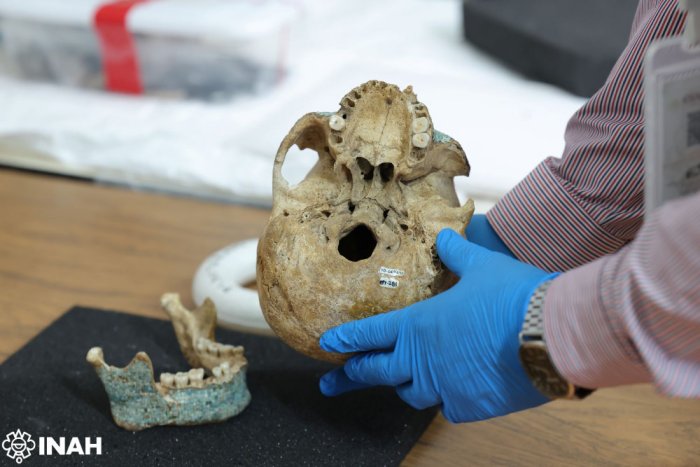
Alejandro Bautista Valdespino, Deputy Director of the Registry of Movable Archaeological Monuments, said that DRPMZAH specialists prepared an archaeological report. Using photos from the Mexican Embassy in the Netherlands and analyzing the skull's features, they “concluded that it is a pre-Hispanic human skeletal remains, originating from national territory. This supported the formal request for restitution.”
Credit: INAH
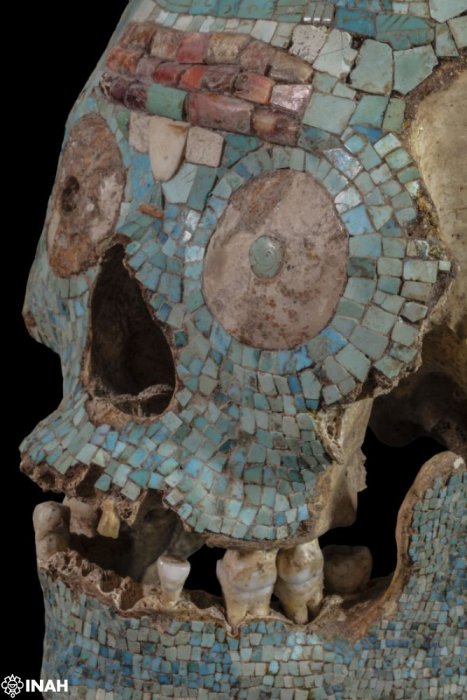
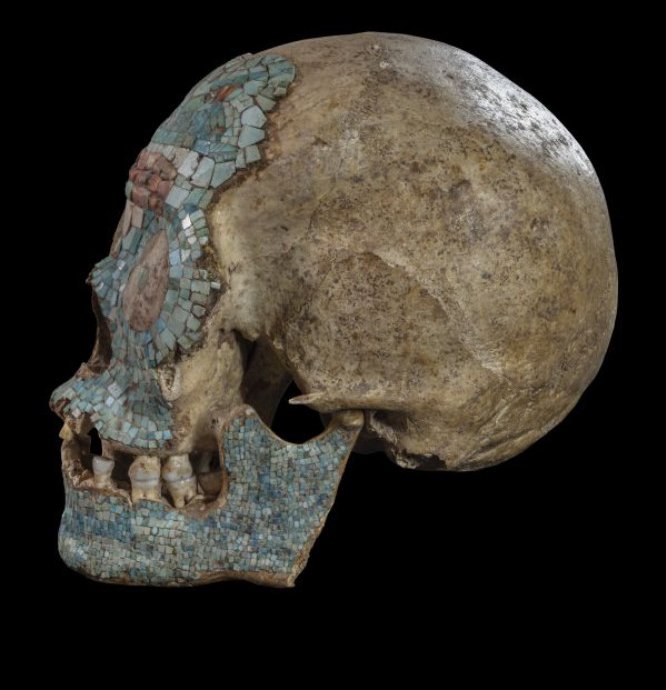
The skull is partly covered with small pieces, like a mosaic, that form a simple snake design on the forehead. The blue pieces are turquoise. The reddish and white pieces, found between the eyebrows and in the eyes, are shell. The left eye socket contains jadeite, and the snake's eye is made of rock crystal.
In 2011 and 2012, the Dutch museum worked with the French Center for Research and Restoration of Museums to check if the skull was authentic. Tests such as isotope analysis, X-ray fluorescence, and osteobiographical studies showed that the skull belonged to a man between 25 and 40 years old, and that the mosaic materials are also pre-Hispanic.
However, experts found modern glue in some parts of the skull, used to hold the mosaic pieces in place. This could mean the decoration was rearranged or reused by the original owner before the museum bought it.
When registering the skull with the Public Registry, museum technician José Mejía Lozano created special packaging to handle it safely. Photographer Christian Esparza Espinosa also made the first 3D digital model of the skull.
Credit: INAH
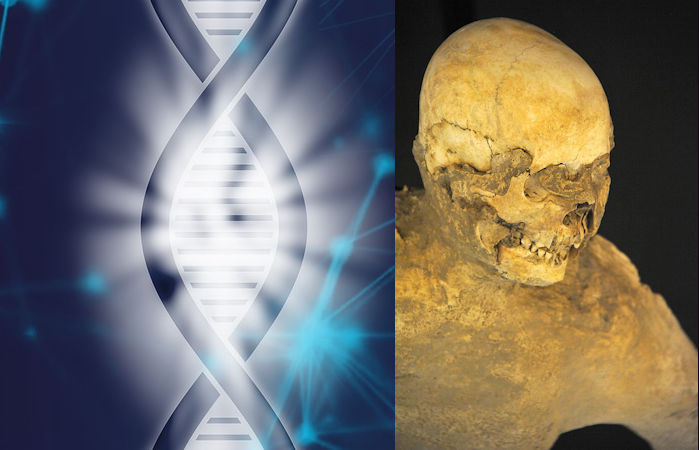
Physical anthropologist Olaf Bello Cardoso from DRPMZAH says the skull can provide both biological and social information. Further studies, like radiocarbon dating, could help. He believes it is possible to obtain samples from teeth or the temporal bone, the hardest part of the skull, which often preserves ancient DNA.
See also: More Archaeology News
“From an anthropological perspective, in addition to conducting physical analyses of the skull, it is important to decipher who the person behind the turquoise mosaic is. For example, it is known that the skull from Tomb 7 of Monte Albán was part of an offering dedicated to a principal figure; in the case of the now repatriated skull, it is possible that the intention was to exalt the individual with the ornamentation of his skull,” he notes.
Finally, Bautista Valdespino says that the Yucu Saa Community Museum in Villa de Tututepec, Oaxaca, is interested in displaying the skull. They are working together to make sure the right conditions are in place for its proper exhibition.
Source: INAH
Written by Jan Bartek - AncientPages.com Staff Writer