AncientPages.com - On August 29, 1475, the Treaty of Picquigny ended a brief war between England and France.
It was a significant historical peace treaty that followed the invasion of France by Edward IV of England, in alliance with Burgundy and Brittany.
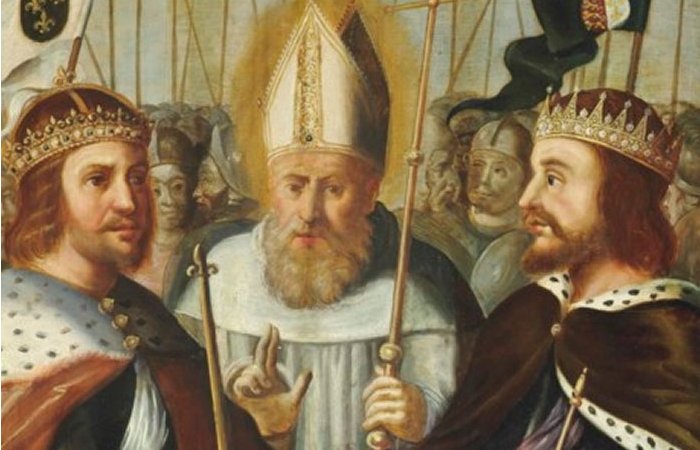
Alliance between the King of England and the King of France, most likely a depiction of the Treaty of Picquigny. Oil on panel, created by an artist from the circle of Jean Chalette (died 1643). Image credit: - https://www.christies.com/lot/lot-5747314 - Public Domain
It left Louis XI of France free to deal with the threat of Charles the Bold, Duke of Burgundy.
Edward IV had invaded France in alliance with Charles the Bold, Duke of Burgundy, landing in June with a force of around 16,000 troops. The plan was to march through the Burgundian territory to Reims. However, Charles failed to provide the support he had promised and refused to allow the English to enter towns under Burgundian control.
Louis then sent Edward word that he was willing to offer more than Edward's allies could. He induced Edward to negotiate a settlement. The two negotiated by meeting on a specially built bridge with a wooden grille barrier between the sides at Picquigny, just outside Amiens.
The negotiations led the two kings to agree to a seven-year truce and free trade between the two countries. Louis XI was to pay Edward IV 75,000 crowns upfront, essentially a bribe to return to England and not take up arms in pursuit of his claim to the French throne. He would then receive a yearly pension after that of 50,000 crowns. Also, the King of France was to ransom the deposed Queen Margaret of Anjou, who was in Edward's custody, with 50,000 crowns. It also included pensions to many of Edward's lords.
There were also several other provisions of this treaty that some disagreed with.
Philippe de Commines, the chronicler, says that Richard, Duke of Gloucester (later Richard III), is considered dishonorable for violating the treaty. Also, the English envoy to Spain, Louis de Bretaylle, confided that this one shady deal took away the honor of all Edward's previous military victories.
Edward IV had invaded France in alliance with Charles the Bold, Duke of Burgundy, landing in June with a force of around 16,000 troops. The plan was to march through the Burgundian territory to Reims. However, Charles failed to provide the support he had promised and refused to allow the English to enter towns under Burgundian control.
Louis then sent Edward word that he was willing to offer more than Edward's allies could. He induced Edward to negotiate a settlement. The two negotiated by meeting on a specially built bridge with a wooden grille barrier between the sides at Picquigny, just outside Amiens.
The negotiations led to an agreement: the two kings agreed to a seven-year truce and free trade between the two countries. Louis XI was to pay Edward IV 75,000 crowns upfront, essentially a bribe to return to England and not take up arms in pursuit of his claim to the French throne. He would then receive a yearly pension thereafter of 50,000 crowns. Also, the King of France was to ransom the deposed Queen Margaret of Anjou, who was in Edward's custody, with 50,000 crowns. It also included pensions to many of Edward's lords.
There were also several other provisions of this treaty that some people disagreed with.
Philippe de Commines, the chronicler, says that Richard, Duke of Gloucester (later Richard III), was opposed to the treaty, considering it dishonorable. Also, the English envoy to Spain, Louis de Bretaylle, confided that this one shady deal took away the honor of all Edward's previous military victories.
AncientPages.com
[expand title="Expand for references"]
References:
Seward D. A Brief History of the Hundred Years' War: The English in France, 1337-1453
[/expand]