Ellen Lloyd – AncientPages.com – When darkness falls and it gets colder, we gather at home to share ghost stories that can be either amusing or truly frightening. These tales, passed down through generations or newly imagined, often serve as entertainment while exploring the thin line between reality and the supernatural.
Ghost stories are not only a way to bond with family and friends but also reflect cultural beliefs and fears. The tradition of telling ghost stories dates back centuries, evolving over time as it adapts to different cultures and storytelling styles.
In some regions, these narratives incorporate local folklore or historical events, adding an element of authenticity that enhances their chilling effect. Whether around a warm fireplace or during a camping trip under the stars, ghost stories remain an integral part of many cultural traditions worldwide. They continue to captivate audiences by blending suspense with curiosity about what lies beyond our understanding.
Yet, let us not forget that telling a ghost story and experiencing a chilling supernatural encounter are worlds apart. Around 2,000 years ago, a scholar found himself in an unfortunate situation at a site inhabited by a troubled spirit. In those ancient times, it was commonly believed that ghosts were restless souls unable to find peace, a belief that persists to this day.
The ancient Romans thought that the spirits of the deceased dwelled in perpetual darkness alongside various underworld gods and non-human entities. According to their calendar, certain dates in May, August, October, and November were believed to be when these spirits could appear on Earth. Similarly, the ancient Celts held that during times when the boundary between the living and dead blurred, spirits from the Otherworld could enter our realm. The ancient Greeks held dual beliefs about ghosts. They perceived them not only as weak, smoke-like entities that were harmless, but also as spirits capable of potentially leaving their graves to harm humans. This reflects the complexity of Greek mythology and its views on the afterlife and supernatural beings.
The supernatural tale we recount today involves an encounter with an unsettling entity that relentlessly haunted an ancient scholar until, one day, everything changed when he took an action few would have dared consider.
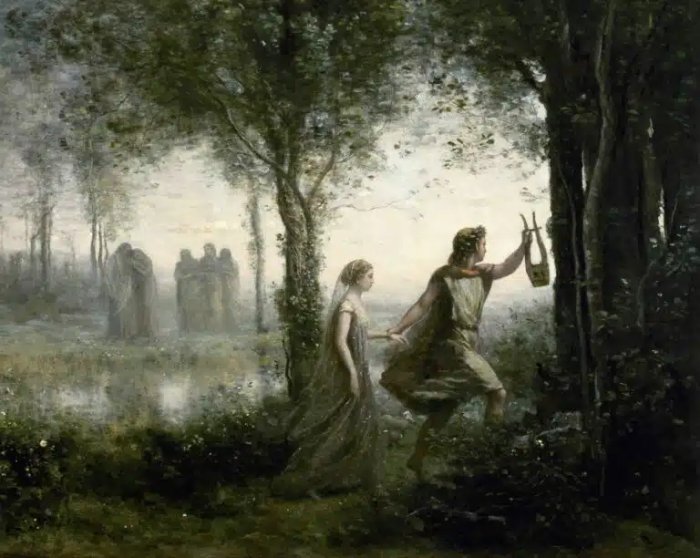
In the mythological tale of Orpheus embarks on a journey to retrieve his beloved Eurydice. Guided by spectral figures, he navigates the realm of the dead with determination and hope. This story highlights themes of love, loss, and perseverance as Orpheus attempts to bring Eurydice back to the world of the living. Orpheus Leading Eurydice from the Underworld by Jean-Baptiste Camille Corot (1796–1875). Credit: DcoetzeeBot. Public Domain
Several ancient writers and philosophers have documented an intriguing case of a spirit haunting a house in Athens. There are different versions of the story, and we will present the account written by Pliny the Younger (61/62 CE–c. 113 CE), a lawyer, author, and magistrate of Ancient Rome. Pliny the Younger wrote hundreds of letters, of which 247 survived and hold historical value. In one of his letters, we find the account of a scholar’s encounter with a ghost.
When writing to his peer, Licinius Sura, Pliny, who himself believed in the existence of ghosts, wrote, “I should very much like to know whether you think that ghosts exist, and have a form of their own and some sort of supernatural power, or whether they lack substance and reality and take shape only from our fears.”
As the story unfolds, we find Athenodorus Cananites, a Stoic philosopher from the 1st century BC, embarking on a journey to Athens in search of accommodation. His quest led him to discover a large yet surprisingly affordable house. It seemed a little odd that such a large and luxurious property was cheap. Upon further inquiry, he learned that the property was reputedly haunted, a fact that had discouraged others and accounted for its modest price.
Undeterred by tales of spectral inhabitants, Athenodorus chose to rent the house. He envisioned it as an ideal sanctuary for study and writing—an opportunity too promising to pass up.
However, it wasn’t long before Athenodorus sensed an unusual presence within those walls. What could this be? he pondered, intrigued.
Pliny the Younger documented accounts from former residents who fled a particular house in fear. These individuals reported experiencing sleepless nights due to persistent metallic rattling and clinking noises, which they attributed to a ghost moving through the mansion. While this apparition of an old man was never known to cause physical harm, the unsettling sounds it produced were described as terrifying.
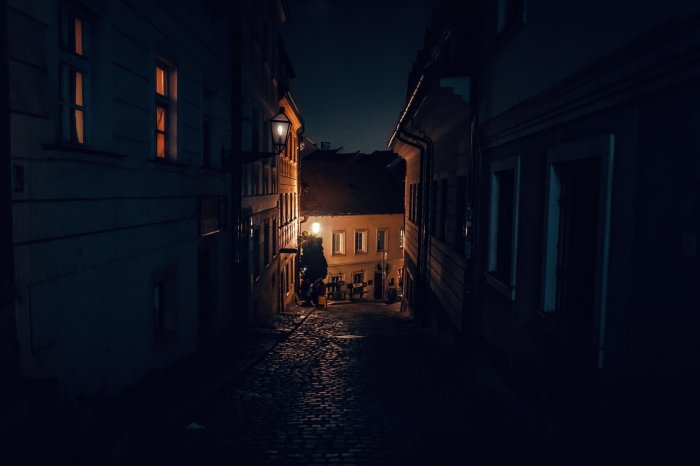
Credit: Michael_Pointner – Pixabay – Public Domain
“At dead of night, the clanking of iron, and if you listened carefully, the rattle of chains could be heard, some way off at first, and then close at hand. Then there appeared the spectre of an old man, emaciated and filthy, with a long flowing beard and hair on end, wearing fetters on his legs and shaking the chains on his wrists,” Pliny the Younger wrote, describing the ghost and sounds.
One evening, as Athenodorus immersed himself in his work, he began to hear faint rattling chains, a sound that gradually intensified until it seemed just beyond his door.
“At first there was nothing but the general silence of night; then came the clanking of iron and dragging of chains. He [Athenodorus] did not look up nor stop writing, but steeled his mind to shut out the sounds. Then the noise grew louder, came nearer, was heard in the doorway, and then inside the room.
He looked round, saw and recognized the ghost described to him. It stood and beckoned, as if summoning him. Athenodorus in his turn signed to it to wait a little, and again bent over his notes and pen, while it stood rattling its chains over his head as he wrote. He looked round again and saw it beckoning as before, so without further delay he picked up his lamp and followed. It moved slowly, as if weighed down with chains, and when it turned off into the courtyard of the house it suddenly vanished…” Pliny described the chilling encounter that occurred in the dark hours.
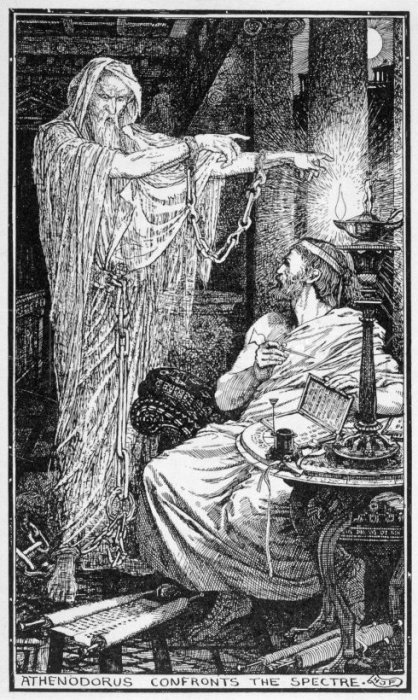
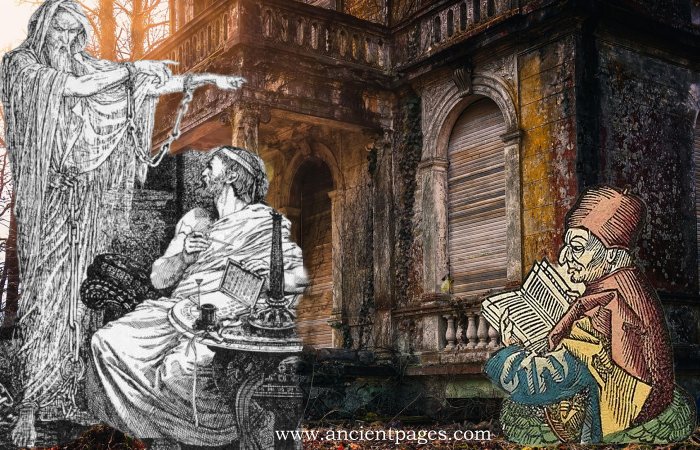
Athenodorus confronts the Spectre”. Illustrating a story told by Pliny the Younger about the Greek Stoic philosopher Athenodorus who rented a haunted house. Engraving by Henry Justice Ford, from The Strange Story Book by Leonora Blanche Lang; Andrew Lang.
Was it a ghost or a product of Athenodorus’s vivid imagination?
Without regard for the consequences and setting aside his fear, Athenodorus bravely followed the ghost of the old man bound in chains to the courtyard, where it vanished unexpectedly into thin air. The following morning, still unsettled by the night’s events, Athenodorus marked the spot of its disappearance and informed local magistrates. Responding to this information, Athenian authorities excavated the area and uncovered a skeleton bound in chains. After ensuring a proper burial for these remains, the ghost was never seen again.
This ancient tale invites reflection on Greek beliefs about the afterlife and supernatural phenomena. In both ancient Greece and Rome, ghosts were often perceived as spirits of those who had died unjustly or without receiving proper burial rites. The Greeks held that such restless souls could not find peace in their afterlife—a belief that resonates with many cultures even today.
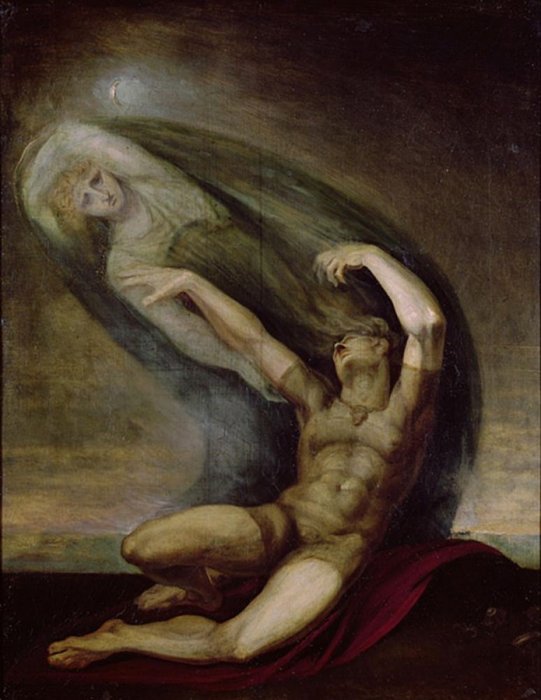
Achilles tries to seize hold of Patroclus’ ghost. Credit: Henry Fuseli (1741–1825) Public Domain
There are several spooky tales of haunted houses from ancient Greece and Rome. For example, in Suetonius’s “The Life of Caligula,” the narrative surrounding the fallen emperor’s burial is far from ordinary. The Lamia Gardens, where he was laid to rest, became a site of eerie occurrences and ghostly sightings, leaving one to ponder whether it was Caligula himself or the spirits of his victims haunting the grounds. This motif of a tyrant’s careless burial invites reflection on the restless spirit of an emperor whose life ended in turmoil. Suetonius captures this lingering fear with a touch of irony, suggesting that even in death, Caligula’s presence remained unsettling.
This theme resonates through history and literature. Plutarch recounts tales like that of Damon, entombed in Chaironeia’s public bath—a story that echoes haunted narratives across cultures. In Plautus’s “Mostellaria,” we find another spectral tale set in Athens, where Tranio spins a yarn about Diapontius’s unburied ghost amidst youthful mischief reminiscent of Pliny’s accounts.
In the play, Tranio relies on Theopropides’ lack of courage, anticipating that the mention of a ghost will frighten him away. Theopropides, known for his miserly nature and as the father of Philolaches, unexpectedly returns home early from a business trip. To conceal his son’s misbehavior—of which Tranio is also guilty—Tranio takes action. He confines Philolaches and his inebriated friends inside the house, instructing them to remain silent. Exploiting Theopropides’ superstitious tendencies, Tranio deceives him by claiming that Philolaches has moved out because the house is haunted.
Even Homer’s “Iliad” presents us with Patroclus pleading for proper rites to enter the underworld—perhaps one of Greek literature’s earliest ghost stories. These enduring tales remind us that humanity has long been captivated by ghosts and will likely remain intrigued by these spectral echoes from our past for generations to come.
Written by Ellen Lloyd – AncientPages.com
Copyright © AncientPages.com All rights reserved. This material may not be published, broadcast, rewritten or redistributed in whole or part without the express written permission of AncientPages.com
[expand title=”Expand for references”]
Levente Nagy – Ancient Greek and Roman Ghost Stories. Some New Approaches, In: Angels, Demons and Representations of Afterlife within the Jewish, Pagan and Christian Imagery. (Ed.: Iulian Moga) Iasi, 2013., 225-244.
The Letters of Pliny the Younger
Suetonius – The Life of Caligula
Felton, Debbie. “Folkloric Anomalies in a Scene from the ‘Mostellaria.’” Quaderni Urbinati Di Cultura Classica 62, no. 2 (1999): 123–42.
[/expand]