Ellen Lloyd – AncientPages.com – In a remote, high-altitude Andean town in Peru, difficult to reach, reporters and investigators encountered a mystery that remains unsolved. The settlement, which prospered long before the rise of the Inca Empire, is home to impressive ancient structures and ruins left by a long-vanished people.
Because of its natural beauty and rich historical background, the town has long attracted explorers and researchers. However, visitors have also reported a series of unusual and unexplained phenomena. These include mysterious rocks that seemed to appear without a clear origin, strange events occurring inside one family’s home, and reports of an unknown form of energy said to permeate the area.
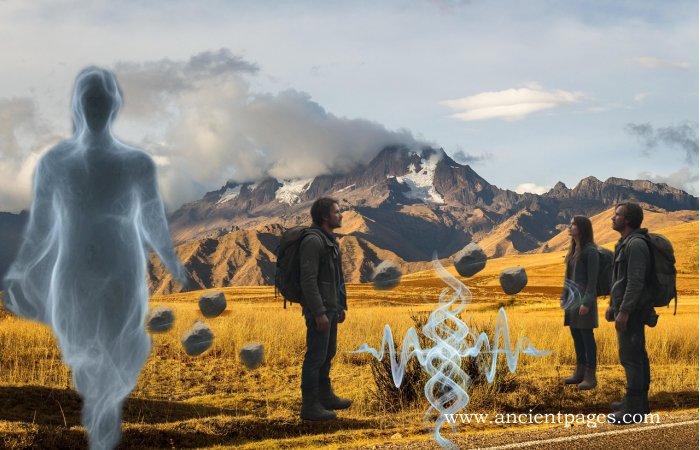
Something unusual is occurring here, and this location is clearly out of the ordinary. Similar unexplained events have been documented in numerous other countries, raising an important question: could this be part of a broader, unexplained phenomenon occurring on a global—or even universal—scale?
Despite multiple investigations, no definitive explanations have been found for these occurrences. The case remains open to interpretation, inviting readers to consider what might have happened and why the reported incidents continue to defy conventional explanation.
In the 1930s, a young American mining engineer named Jack Baragwanath spent several years traveling through some of the most remote regions of Chile and Peru. During his journeys, he encountered many vivid and dramatic experiences. The Andean landscape in particular seemed to invite the strange and otherworldly. Yet, among all these adventures, one episode involving what appeared to be a poltergeist left the deepest impression on him.
At the age of twenty-seven, Jack was sent by his company to a small settlement in central Peru to oversee the operation of a modest but exceptionally rich copper mine. The village was called Jauja, situated about eighty miles east of Lima in the Andes.
At that time, Jauja was little more than a village; today, it is regarded as a small town. On a low ridge just beyond the town lies a series of intriguing circular stone structures, built without mortar and resembling granaries. Scattered around them are the remains of substantial fortifications. Together, these features quietly testify to the long presence of a people who lived here long before our time.
Long before the Inca era, the region had been inhabited by the Xauxa people.
Baragwanath was twenty-seven when he arrived in Jauja. He later documented what he experienced there in his book Pay Streak, reflecting on events that had clearly stayed with him over the years.
“Not long after I took my job as an exploration engineer for the Cerro de Pasco Company, I witnessed a phenomenon that still leaves me without an explanation. It happened in the little village of Jauja, in central Peru, where I had been sent to take temporary charge of a small but very rich copper mine for the company.
I am no great believer in what is called the supernatural. To me, it is a convenient word, used too freely to describe any occurrence that cannot be explained readily on logical grounds. Yet I must admit that such matters as ghosts, the various species of wraiths and spooks, thought transference, and other spiritualistic manifestations have always fascinated me,” Baragwanath explained in his book.
Baragwanath rented a house in Jauja, where he met a young, well-educated French priest serving the local church. The priest agreed to help him with his French, and the two quickly became close friends, spending many pleasant hours together each day.

Laguna de Paca en Jauja, Junin, Peru. Credit: Martintoy – CC BY-SA 3.0
One day, the priest, Father Conde, visited Baragwanath in an unusually agitated state. Normally calm and composed, he was clearly disturbed. He explained that something strange was happening in the village.
A few days earlier, an Indigenous man named Vasquez had come to the rectory, urgently asking Father Conde to visit his home and perform an exorcism. Vasquez claimed that spirits had taken over the house and were tormenting his family. For over a week, while they were inside the house, family members had been struck by stones thrown by invisible forces. These incidents occurred both during the day and at night, even when the doors were shut and the shutters securely bolted, as was customary in Peru.
Vasquez was so distressed that it was clear something unusual was occurring. In response, Father Conde visited the house, blessed the family, and sprinkled holy water in an attempt to stop the disturbances. Despite his efforts, the strange phenomena continued, and he confessed that he could not explain what was happening by any normal means.
Naturally adventurous and intrigued by the idea of investigating the supernatural, Baragwanath proposed that they undertake a ghost-laying expedition together by visiting the Vasquez family’s house.
“Father Conde’s story impressed me, for I knew he was not a man to be easily duped. He said we could go there at any time and agreed to set out with me immediately,” Baragwanath recalled.
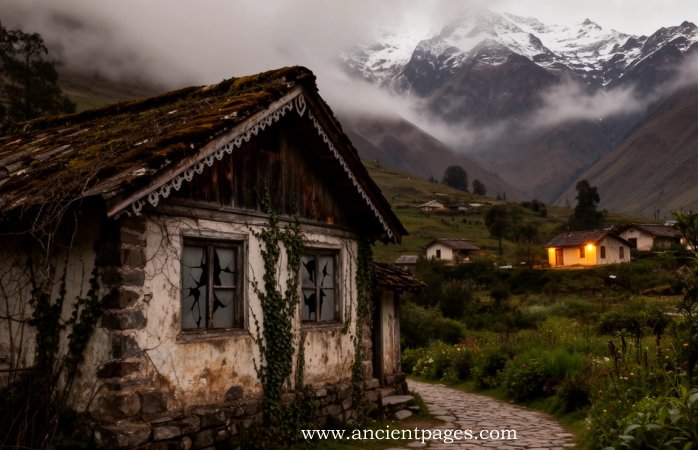
Together with the Mayor, who was also interested in understanding the situation, Baragwanath and Father Conde visited a house reportedly haunted by evil spirits. The three men went directly to the Vasquez residence, a one-story adobe-brick building with a rough tile roof. Inside, they found a simple layout: a combined living room and kitchen, a bedroom, and a storeroom.
They learned that the household consisted of Mr. Vasquez, his wife, and their three daughters, aged between eight and fifteen. Mrs. Vasquez was in a highly distressed, hysterical state. Her face and hands were covered with bruises and bumps, and her daughters also showed numerous bruises.
The family then showed the visitors a collection of objects: rocks ranging from small pebbles to cobblestones, broken tiles, and lumps of hard, dried mud. According to Mrs. Vasquez, these items had been thrown at the family over the previous ten days. Notably, none of the objects had ever struck Mr. Vasquez himself, and no family member had been hit while outside the house.
What invisible force could be responsible for throwing the rocks at the family members?
After thoroughly examining the premises, Baragwanath, the French priest Father Conde, and the Mayor asked the family for permission to remain and observe, hoping to witness the unusual events for themselves. Although the mother and daughters initially reacted with tears and strong objections, they eventually agreed after considerable persuasion.
Baragwanath and Father Conde brought a chair from the living room and placed it in the center of the nearly empty storeroom. Through a combination of threats and promises, they convinced one of the daughters—an intelligent-looking girl of about twelve, whose head, face, and shoulders were already badly bruised and cut—to sit in the chair. They then closed the heavy wooden door to the living room and positioned themselves—Conde, the Mayor, and Baragwanath—shoulder to shoulder in the doorway, their backs against the door.
The girl sat facing them in the middle of the room. Behind her was a small, four-paned window, tightly nailed shut, set deep into the wall and opening onto the street. There were no other openings. The three men carefully inspected the walls, ceiling, and hard-packed mud floor, confirming that there was nowhere anyone could be hiding.
They waited in silence for some time, with nothing occurring for roughly twenty minutes. Their attention, initially fixed on the girl, had likely begun to drift when a sudden incident broke the stillness. They heard a sound like a dull slap followed by a thud and saw a stone, about the size of two clenched fists, rolling across the floor. The stone had struck the girl on the cheek with enough force to jerk her sideways, though not enough to knock her from the chair. She immediately covered her face with her hands and began to sob, but remained seated. While the priest and Baragwanath remained at the door, the Mayor, visibly excited, ran forward and seized the stone.
“This cannot be!” Father Conde cried out in disbelief.
While he held the heavy door firmly shut, the three visitors carefully examined every inch of the room—the walls, the ceiling—searching for any opening through which a stone might have been thrown. They found nothing.
“The girl,” Baragwanath later reflected, “had been struck on the cheek, which meant the stone must have come from one side of the room. Yet all three of us were certain there had been no stones on the floor beforehand. And if the girl had hidden it on her person, she would have needed the skill of a practiced sleight-of-hand artist to produce it without our noticing.”
“There is some terrible fake here,” the Mayor shouted. “That must be a false window.” With that, he threw a stone at the window and smashed it. Keeping the door closed, we went inch by inch over the walls and ceiling of the room, trying to find a place through which the stone might have been thrown, but there was no opening of any kind. The girl had been hit on the cheek, so the stone must have come from one side of the room. It had not been thrown with much force, or it would have knocked her off the chair. From the sound of the thud and the effect of the blow, it seemed as if it had been thrown underhand from a distance of about six feet. It could not possibly have come from the ceiling, the window, or the door, even if these apertures had been open. We were completely baffled.
The little girl’s cheek was beginning to swell, and we did what we could to soothe her. While the Mayor remained with Father Conde, who began again to bless the family, I went out and bought some beer for the father and mother and a few trinkets and sweetmeats for the girls, and we left them as happy as they could be under the circumstances.
I followed the case quite carefully. The strange visitations continued for about a week more and then stopped as suddenly as they had begun. It was just in time, too, for the family seemed on the way to complete insanity.

I do not expect anyone to believe this story, because I don’t believe it myself. I have simply attempted to recount as faithfully as possible exactly what I saw and what happened. For years I have tried to find some explanation for this fantastic episode but am no nearer a solution now than I was that afternoon in Jauja, when Father Conde, the mayor and I, very shaken by what we had seen, left the Vasquez house to steady our nerves in the barroom of the little hotel,” Baragwanath wrote.
It is also worth mentioning that the Jauja incident was also mentioned by Lt.-Col. P. H. Fawcett in the book Exploration Fawcett.
Fawcett made an intriguing observation, saying that “not the least strange part about it was that the stones or rocks hurled came from a very considerable distance, for they were not of a kind found within many miles of Jauja.” Fawcett confirms that the French priest was unable to stop the unexplained phenomena, which eventually ended by itself, and “no apparent reason for it was ever given.”
For hundreds of years, people worldwide have reported curious cases of a mysterious stone-throwing phenomenon that no one can adequately explain.
Hundreds of people have witnessed strange outbreaks of stone-throwing, but who are the invisible assailants responsible for the unjustified attacks? Readers who are interested in exploring this subject further can read our article: Strange Reports Of A Mysterious Stone-Throwing Phenomenon And Invisible Entity Encountered Worldwide
Written by Ellen Lloyd – AncientPages.com
Copyright © AncientPages.com All rights reserved. This material may not be published, broadcast, rewritten, or redistributed in whole or in part without the express written permission of AncientPages.com
[expand title=”Expand for references”]
Lt.-Col. P. H. Fawcett – Exploration Fawcett
[/expand]