Conny Waters – AncientPages.com – Researchers have studied hundreds of unusual figures and symbols carved into ancient cave walls. Made between 18,500 and 14,000 years ago, this rock art is known for its distinct patterns.
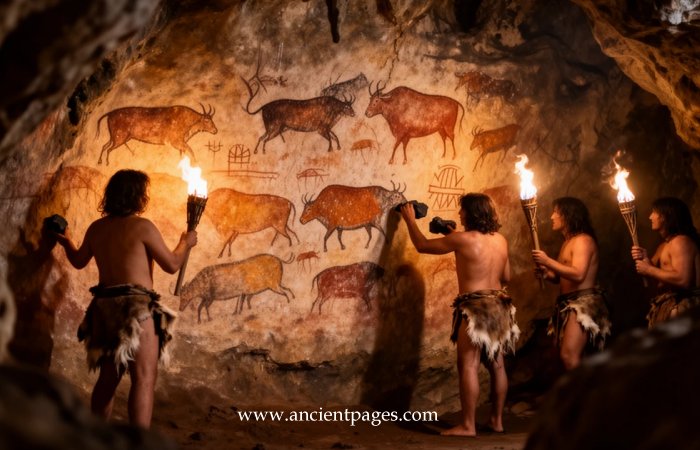
Each figure was placed with intention. But why did ancient people create them? What messages were these artists trying to share, and have we made progress in understanding their meaning? Can scientists figure out what the unusual patterns and these mysterious rock art figures represent?
The mystery of ancient cave paintings has sparked debate for generations. For years, many saw these artworks as little more than scattered images of animals and symbols, lacking deeper meaning.
Yet new research hints that Europe’s hunter-gatherers may have shared a visual language, adding new meaning to the images they painted on stone walls.
A recent study in the Journal of Archaeological Method and Theory presents compelling evidence that our ancestors developed a visual grammar largely overlooked by modern scientists.
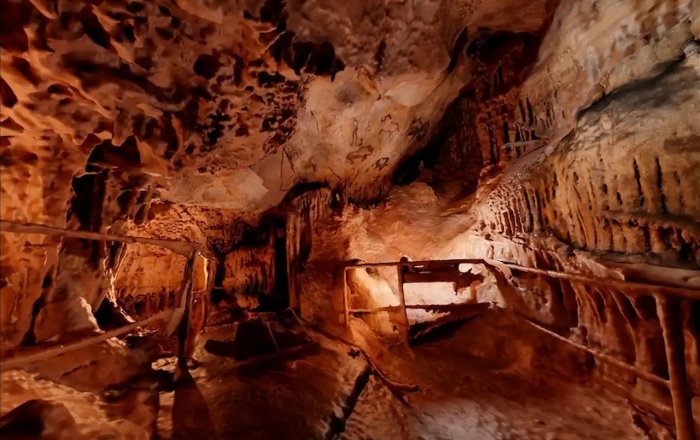
This reconstruction depicts the lighting conditions in the cave of Santimamiñe before its closure to the public in 2007. Credit: I. Intxaurbe 2026
Iñaki Intxaurbe, a researcher from the University of the Basque Country and the University of Bordeaux, used network analysis, math, and advanced statistics to study more than 500 figures from nine caves in the Bay of Biscay, between Spain and France. These figures are from the Magdalenian period, which lasted from 18,500 to 14,000 years ago.
An Ancient Visual Grammar
The study found that this cave art is not arranged randomly. Instead, it follows repeating patterns, hierarchies, and formal rules, suggesting a real graphical ‘grammar.’
But why would people living more than 14,000 years ago develop a visual grammar, and do the cave paintings convey a message?
Intxaurbe explains that the goal was not to interpret the meaning behind these cave patterns. Instead, he studied which motifs appear together, how they are arranged, and whether certain animals follow specific rules. The findings show that cave art is carefully organized rather than random.
The results show that the patterns we observe are not solely due to modeling choices or weighting methods. Instead, they reflect a consistent organization.
Overall, the stable organizational and network results suggest a basic system that shapes how themes are combined and arranged in Magdalenian cave art. This system operates on several levels: repeated theme groups within panels, a ranking in which some motifs are more important, and spatial patterns showing that motifs are unevenly distributed across different areas and are repeated. In this system, large plant-eating animals like bison, horses, and ibexes are the main themes, while other motifs play supporting or connecting roles.
The analyses also show that the animals follow certain conventions.
Bison and ibex are more often shown facing left, while horses usually face right. Horses are typically depicted horizontally, whereas bison are more often shown obliquely or vertically.
The researchers describe the images as a structured system of hierarchies and rules, rather than a random assortment of motifs.
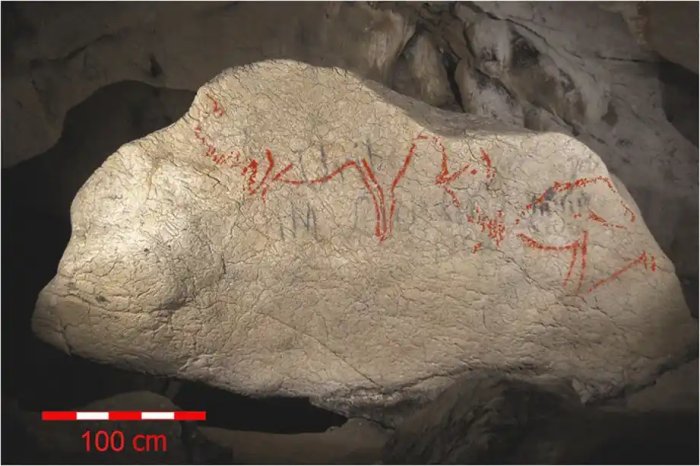
Panel “Lum.D.II” from the cave of Lumentxa (Lekeitio, Basque Country), bearing two bison figures (Lum.D.II.01 and 02) oriented to the left and a horse head (Lum.D.II.03) oriented to the right, illustrating the contrasted directional preferences documented for these taxa in Magdalenian cave art. This configuration provides a clear visual example of the recurrent opposition observed in both regional and supra-regional analyses, whereby bison tend to be oriented leftwards and horses rightwards. Credit: I. Intxaurbe 2026
Even when the analyses are repeated using different statistical methods, the same three animals emerge as the underlying elements of the art.
This indicates that artists shared common principles, which varied by region and period. Paleolithic communities likely followed general guidelines, adapting them to local contexts.
According to the researcher behind the study, the method provides a new tool for examining prehistoric visual art.
“The analyses presented in this study provide convergent and solid evidence that the spatial and thematic organization of Magdalenian parietal art along the Bay of Biscay axis is not random. The network results support the existence of an underlying organizational grammar that governs the combination and distribution of themes in Magdalenian cave art,” the researchers write in their study.
Symbolic Meaning Of The Rock Art Remains Unknown
In the study, scientists repeatedly emphasized that the goal was to provide a methodological tool for objectively and reproducibly analyzing prehistoric symbolic systems, not to decipher the meaning of cave art symbols.
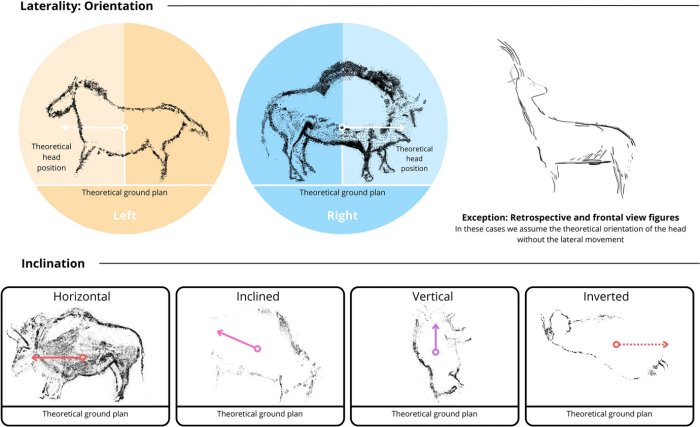
Orientation (laterality) is defined according to the theoretical direction indicated by the body axis or, when identifiable, by the head of the figure. Figures are classified as Right when the body or head points to the right, and as Left when it points to the left. Non-figurative representations (abstract signs) are coded as N.F. In cases of frontal or retrospective views, where laterality cannot be directly observed, the theoretical orientation of the head is inferred without assuming lateral movement. Inclination is defined according to the arrangement of the figure’s body relative to the theoretical ground plan of the cave. Figures are classified as Horizontal when the body is parallel to the cave floor, Inclined when arranged diagonally, Vertical when oriented orthogonally to the ground plan, and Inverted when the body is parallel to the ground plan but with the legs pointing upwards. The tracings belong to the figures (from the up-left part towards the right and the low part) S.D.III.06 (Horse); S.D.III.07 (Bison); Al.C.IV.01 (Ibex); S.D.III.08 (Bison); S.C.I.04 (Bison); S.D.III.04 (Bison); Al.E.I.15 (Bison). Credit: I. Intxaurbe 2026
“We deliberately refrain from advancing speculative interpretations concerning symbolic meaning or narrative content. While the analyses demonstrate structured organization and relational regularities, they do not—and cannot—provide direct access to the social meanings or underlying symbolic intentions.
Rather than offering definitive interpretations, this work should be understood as a methodological contribution and an invitation to further comparative research.
More broadly, the approach offers a formal tool for investigating the internal organization of symbolic systems and is therefore potentially relevant to adjacent fields such as epigraphy, paleography, or historical linguistics, where co-occurrence and combinatorial structure play a central role. The accumulation of comparable, well-documented datasets and the adoption of shared analytical frameworks represent the most promising path toward refining our understanding of Paleolithic graphic systems,” the study concludes.
Put simply, until scientists unveil a theory that reveals the meaning behind the visual grammar sprawled across Europe’s cave walls, the mystery remains ours to contemplate. What inspired our ancestors to fill stone canvases with animals facing every direction? Surely there was a reason—or was there not?
Written by Conny Waters – AncientPages.com Staff Writer
Copyright © AncientPages.com All rights reserved. This material may not be published, broadcast, rewritten or redistributed in whole or part without the express written permission of AncientPages.com
[expand title=”Expand for references”]
Intxaurbe, I. Mapping the Symbolic Structure of Palaeolithic Rock Art Using Co-occurrence Network Analysis. J Archaeol Method Theory 33, 59 (2026). https://doi.org/10.1007/s10816-026-09796-y
[/expand]